Orbital Weld Head Comparison: Types, Features & Selection
Compare orbital weld head types — enclosed, open, and pipe heads. Covers size ranges, applications, and how to choose the right head for your project.
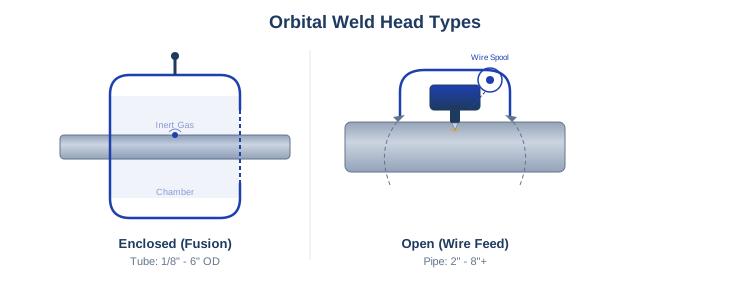
Overview
Choosing the right orbital weld head determines everything downstream: weld quality, joint consistency, gas coverage, and how fast your crew can move through a spool. The three main categories -- enclosed (fusion) heads, open (wire-feed) heads, and combination/pipe heads -- each serve distinct applications. Pick wrong and you are either fighting fitup issues on every joint or burning money on capability you do not need.
This guide breaks down each weld head type with real specs, size ranges, and practical selection criteria so you can match the head to the work rather than the other way around.
The Three Main Weld Head Types
Before diving into specs, here is the quick summary. Enclosed heads dominate small-diameter tube work where full gas shielding matters most. Open heads handle larger pipe where wire feed and operator visibility are necessary. Combination heads try to bridge the gap for mid-range applications.
Side-by-Side Comparison
| Specification | Enclosed (Fusion) Head | Open (Wire-Feed) Head | Combination / Pipe Head |
|---|---|---|---|
| Size Range | 1/16" to 6" OD (typical) | 2" to 170"+ OD | 1.5" to 8" OD |
| Weld Process | Autogenous GTAW (no filler) | GTAW with cold or hot wire | GTAW, autogenous or with wire |
| Gas Coverage | Full 360-degree enclosure | Trailing shield or local cup | Partial enclosure or local shield |
| Joint Types | Butt welds, tube-to-tubesheet | Butt welds, fittings, flanges | Butt welds on mid-range tube/pipe |
| Setup Time | 2-5 minutes typical | 10-20 minutes typical | 5-10 minutes typical |
| Weld Quality | Excellent ID purge control | Depends on purge dam setup | Good with proper purge |
| Cooling | Air-cooled or water-cooled | Water-cooled (standard) | Water-cooled (typical) |
| Typical Cost | $3,000-$15,000 per head | $8,000-$40,000+ per head | $6,000-$20,000 per head |
| Best For | Pharma, biotech, semiconductor | Power, petrochemical, shipbuilding | Process piping, mechanical |
Enclosed (Fusion) Weld Heads: Detailed Breakdown
Enclosed weld heads -- sometimes called fusion heads or clamshell heads -- are the workhorse of high-purity orbital welding. The head clamps around the tube joint and creates a sealed gas chamber surrounding the entire weld zone. The tungsten electrode rotates 360 degrees inside this chamber, producing an autogenous (no filler metal) fusion weld.
How They Work
The two halves of the head clamp onto the tube with the joint centered in the weld chamber. Inert gas (typically argon at 99.997% purity or better) fills the chamber and provides both shielding and ID purge through the tube bore. The rotor carries the tungsten electrode around the joint at a programmed travel speed while the power supply manages current levels, pulse parameters, and rotation.
Major manufacturers include Arc Machines (AMI), Swagelok (formerly Hines), and Orbitalum. AMI's Model 9 series covers 1/4" to 4" OD and is probably the most widely deployed enclosed head in North America. Orbitalum's orbiweld series covers similar ranges with a modular insert system.
Size Ranges
- Micro heads: 1/16" to 1/4" OD -- used for semiconductor gas lines, analytical instrumentation, and chromatography systems
- Standard heads: 1/4" to 3" OD -- the most common range, covering pharma process piping, biotech facilities, and food-grade tubing
- Large-bore heads: 3" to 6" OD -- used for process piping, heat exchangers, and larger utility systems
Each OD size typically requires a matched collet or insert set. You are not buying one head that covers everything -- you are buying a head body plus a set of inserts or collets for each tube size you run.
Pros
- Complete inert gas shielding eliminates oxidation without separate trailing shields
- Consistent, repeatable welds with minimal operator influence
- Fast setup once the correct insert is loaded
- Ideal for ASME BPE high-purity specifications (surface finish requirements of 20 Ra or better on the ID)
- Compact enough for tight mechanical rooms and rack-mounted tubing
Cons
- Limited to autogenous welding -- no filler wire means wall thickness mismatch or poor fitup kills the weld
- Each tube OD needs its own insert or collet (inventory adds up fast)
- Cannot handle heavy-wall pipe that needs multi-pass wire-feed welding
- Maximum size typically tops out around 6" OD
When to Use Enclosed Heads
Use enclosed heads whenever you are welding thin-wall tubing (typically 0.035" to 0.109" wall) where autogenous fusion is appropriate, and where gas purity at the weld zone is critical. That means pharmaceutical process systems, semiconductor fab gas delivery, biotech fermentation and CIP/SIP piping, and food and beverage sanitary tubing.
If your spec calls out ASME BPE or the customer requires borescope inspection of every weld, an enclosed head is almost certainly your tool.
Open (Wire-Feed) Weld Heads: Detailed Breakdown
Open weld heads mount on the pipe OD and rotate the torch around the joint with full operator visibility. They accommodate cold wire or hot wire feed for single-pass or multi-pass GTAW welding on pipe sizes from roughly 2" OD up to extremely large diameters.
How They Work
The head clamps or mounts to the pipe, and a torch assembly rotates on a ring gear or track around the circumference. The operator (or the power supply's AVC system) manages arc length, and the wire feeder delivers filler metal into the puddle. Shielding comes from the torch cup gas flow, sometimes supplemented by a trailing shield for reactive materials like stainless steel or titanium.
For pipe work, ID purge is handled separately using purge dams, inflatable bladders, or purge plugs positioned upstream and downstream of the joint.
Key players include Arc Machines (AMI Model 227 and Model 415 series), Swagelok/Hines, Polysoude, and Astro Arc. The AMI Model 415 is a common choice for pipe sizes from about 2" to 6.625" OD, while the Model 227 handles larger diameters.
Size Ranges
- Small pipe heads: 1.5" to 6" OD -- typically clamshell-style mount, used for process piping
- Mid-range heads: 6" to 24" OD -- track-mounted, common in power generation and petrochemical
- Large-bore heads: 24" to 170"+ OD -- track or band-mounted systems for pressure vessels, penstocks, and subsea pipelines
Pros
- Handles heavy-wall pipe that requires filler metal and multi-pass sequences
- Full operator visibility of the arc and puddle
- Wire feed enables joining dissimilar thicknesses and filling root gaps
- Covers very large diameters that enclosed heads cannot reach
- AVC (Arc Voltage Control) maintains consistent arc length over fitup variations
Cons
- More complex setup: torch alignment, wire feed angle, purge dam placement
- Gas coverage depends on cup size and trailing shield -- not inherently sealed like an enclosed head
- Larger, heavier equipment with more components to maintain
- Higher cost per head and per rental period
- Slower setup time compared to enclosed heads
When to Use Open Heads
Open heads are the right choice for pipe welding where wall thickness exceeds what autogenous fusion can handle (roughly above 0.109" wall for most materials), where pipe diameter exceeds 6", or where code work requires documented filler metal additions. Power plants, refineries, chemical processing, LNG facilities, and shipyards are the typical environments.
Water-Cooled vs. Air-Cooled
Enclosed heads for small tube sizes (under 1" OD) are often air-cooled, which keeps them lighter and simpler. As tube OD and amperage increase, water cooling becomes necessary to prevent overheating the head body and maintaining tungsten life.
Most open pipe heads are water-cooled by default. The higher currents needed for heavy-wall pipe (often 150-250+ amps) generate too much heat for air cooling alone.
Rule of thumb: If your typical weld current stays below 80 amps and duty cycle is moderate, air-cooled heads work fine. Above that, go water-cooled. For continuous production welding at any amperage, water cooling extends head life and keeps the rotor mechanism within spec.
Water cooling does add complexity: you need a coolant recirculator, hoses, and periodic coolant maintenance. But on a busy job site running dozens of welds per shift, the reliability trade-off is worth it.
Cost Considerations
Orbital weld heads represent a significant capital investment. A single enclosed head body runs $3,000 to $8,000, and you will need insert sets ($500-$1,500 each) for every tube OD in your scope. A full setup covering 1/4" through 2" OD can easily reach $15,000-$20,000.
Open wire-feed heads cost more, with a mid-range pipe head running $10,000-$25,000 and large-diameter track systems reaching $40,000 or more.
Renting vs. Buying
For contractors who do not run orbital welding every week, renting makes strong financial sense. You get current-model equipment, the rental provider handles calibration and maintenance, and you are not sitting on depreciating capital between projects.
Rent Orbital Weld Heads at TechSouth -- TechSouth carries AMI and other major-brand enclosed and open weld heads with full support and training available.
Buying makes sense if you are running orbital welding as a core service, welding daily or weekly, and can keep the equipment utilized. Even then, many shops own their bread-and-butter sizes and rent specialty heads for unusual diameters.
Brand Compatibility
This matters more than people realize. Weld heads are not interchangeable across brands. An AMI head requires an AMI power supply (Model 207, 307, or 415 series). Orbitalum heads pair with their Orbimat or Orbiweld power supplies. Polysoude heads work with Polysoude controllers.
Within a brand family, heads are generally forward-compatible with newer power supplies, but check with your supplier. Running a ten-year-old weld head on a brand-new power supply sometimes requires firmware updates or adapter cables.
If you are renting, this is handled for you -- the rental package should include matched head and power supply. If you are buying piecemeal or adding heads to an existing fleet, confirm compatibility before spending money.
How to Choose: Decision Framework
What is the tube or pipe OD range? If everything is under 4" OD thin-wall tubing, enclosed heads cover you. Over 6" or heavy-wall, you need open heads.
Autogenous or wire feed? If your wall thickness and fitup support autogenous fusion, enclosed heads deliver faster, cleaner results. If you need filler, go open.
What is the specification? ASME BPE and semiconductor specs practically mandate enclosed heads for their gas coverage and repeatability. ASME B31.3 or B31.1 process and power piping often points to open heads with wire feed.
How many OD sizes? If your scope covers a narrow range (say 1/2" to 1.5" OD), one enclosed head body with a few inserts is affordable. If you need to cover 1/4" through 4" plus some 6" pipe, budget accordingly or plan to rent the less-common sizes.
Field or shop? Enclosed heads are lightweight and work well in tight spaces. Open heads need more room and a stable mounting surface. For field work in congested pipe racks, enclosed heads on small tube sizes are far easier to maneuver.
The Verdict
There is no single "best" orbital weld head -- only the right one for the job in front of you. For high-purity tube welding under 4" OD, enclosed fusion heads deliver unmatched gas coverage and consistency. For pipe welding above 6" OD or any heavy-wall application, open wire-feed heads are the only practical option. The mid-range (2" to 6" OD, moderate wall thickness) is where your specific spec, material, and project volume drive the decision.
If you are unsure which head type fits your upcoming project, contact TechSouth for guidance. Their rental fleet covers both enclosed and open heads across a wide range of sizes, so you can match equipment to scope without overcommitting capital.
Get the Orbital Welding Reference Pack
Sizing charts, grinding angle tables, and purge flow rates — all in one printable PDF.
No spam. Unsubscribe anytime.
Ready to get started? TechSouth Inc. carries the equipment mentioned in this guide.
Request Rental from TechSouthRelated Guides
Orbital Welding Equipment Rental Guide
Everything you need to know about renting orbital welding equipment. When to rent vs buy, what's included, and how to get started with TechSouth rentals.
Orbital Welding: Pipe vs Tube — Key Differences Explained
Understand the critical differences between pipe and tube orbital welding. Covers sizing, weld head selection, joint prep, and parameter differences.