Orbital Welding Equipment Rental Guide
Everything you need to know about renting orbital welding equipment. When to rent vs buy, what's included, and how to get started with TechSouth rentals.
When Renting Orbital Welding Equipment Makes Sense
Orbital welding systems are not cheap. A complete setup -- power supply, weld head, coolant system, and tooling -- can represent a significant capital investment, often $30,000 to $100,000+ depending on the configuration and application. For companies that weld every day, that investment pays for itself. But not every project justifies a purchase.
Renting orbital welding equipment gives contractors, facility owners, and maintenance teams access to the same professional-grade systems without the upfront capital expenditure. It is a practical option in several specific situations, and understanding when rental makes sense versus when purchasing is the better call can save your organization real money.
This guide covers the key considerations for renting orbital welding equipment, what to expect in a rental package, cost factors, and the questions you should ask before signing a rental agreement.
When to Rent vs. When to Buy
Renting Makes Sense When:
You have a short-term project with a defined scope. A pharmaceutical facility needs 200 sanitary welds during a shutdown. A semiconductor fab is adding a gas delivery line. A food processing plant is installing new CIP piping. These projects have a clear start date, end date, and weld count. Once the work is done, the equipment sits idle. Renting lets you match equipment availability to project duration without carrying an asset that depreciates between jobs.
You need a specialized size or configuration you don't own. Your shop may own orbital equipment for 1/2" through 2" tube, but a project calls for 4" pipe weld heads or a micro-bore head for 1/8" OD tubing. Purchasing a weld head for a single project you may not see again for two years rarely makes financial sense. Rental fills the gap.
You want to evaluate equipment before purchasing. If you are considering adding orbital welding capability to your operation, renting lets your welders and engineers work with the actual equipment on real projects before committing to a purchase. You learn which power supply features matter to your team, which weld head sizes you need most, and whether the productivity gains justify the investment -- all with hands-on experience rather than spec sheets.
You need to scale up temporarily. Your team owns one orbital system but a large project requires running two or three weld heads simultaneously to meet schedule. Renting additional power supplies or weld heads for the duration of the project is faster and cheaper than purchasing equipment that will be surplus when the job ends.
Buying Makes Sense When:
You have consistent, ongoing orbital welding work. If your shop welds orbital joints weekly or daily, the math favors ownership. Rental costs accumulate. A system that pays for itself in 12-18 months of steady use is a better investment than perpetual rental fees.
You need equipment available on short notice. Owned equipment is in your shop, ready to deploy. Rental equipment requires lead time for availability, shipping, and checkout. For emergency maintenance or fast-turnaround work, having your own system eliminates scheduling risk.
You are building a core capability. If orbital welding is becoming a service your company offers to clients, owning the equipment is part of building that capability. Your welders become proficient on a specific platform, you develop standard procedures, and you control maintenance and calibration.
What a Typical Rental Package Includes
Rental packages vary by provider, but a complete orbital welding rental from a reputable supplier should include everything you need to make welds on day one. Here is what to expect:
Power Supply
The orbital welding power supply is the brain of the system. It controls arc current, travel speed, pulse parameters, gas flow timing, and weld schedules. Rental units should arrive with current software, calibration documentation, and all necessary power cables. Common rental power supplies include systems from Arc Machines (AMI), Swagelok, and Linarc, depending on the supplier's inventory.
Weld Heads
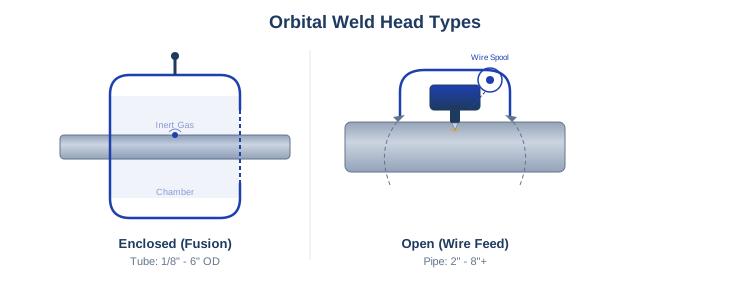
The weld head is the tooling that clamps onto the tube or pipe and rotates the electrode around the joint. Rental packages typically include weld heads sized for your specific project requirements. Enclosed fusion heads for tube welding cover ranges like 1/4" - 1/2", 1/2" - 1-1/2", or 1" - 3" OD. Open-style heads for pipe welding cover larger diameters.
Make sure the rental includes all rotor inserts, clamping inserts, or collet sets needed for the exact tube or pipe sizes on your project. A weld head rated for 1/2" to 2" OD does not help if the rental does not include the specific insert for your 7/8" OD tube.
Coolant System
Enclosed weld heads require a water coolant recirculator to prevent overheating during welding. This is sometimes included in the power supply and sometimes a separate unit. Confirm it is part of the rental. Running an enclosed head without coolant will damage the head and potentially the cable.
Cables, Gas Lines, and Accessories
A complete rental includes the interconnect cable between the power supply and weld head, argon gas hose, coolant hoses (if applicable), a gas regulator or flowmeter, and basic consumables such as tungsten electrodes and collets. Some providers include a tungsten grinder; others offer it as an add-on.
Documentation and Support
Professional rental providers supply operating manuals, quick-start guides, and a point of contact for technical support during the rental period. For operators who have not used the specific equipment before, some providers offer on-site training or remote support as part of the rental package or as a billable add-on.
Cost Considerations
Orbital welding equipment rental pricing typically follows one of these structures:
- Daily rate. Common for short rentals (1-5 days). Expect higher per-day cost but lower total commitment.
- Weekly rate. The most common structure for project-based rentals. Usually priced at 3-4x the daily rate rather than 7x, giving a significant discount for weekly commitment.
- Monthly rate. For extended projects, monthly rates offer the best per-day economics. Typically 2.5-3x the weekly rate.
What Affects the Price
- System complexity. A basic tube fusion setup (power supply + one enclosed head) costs less to rent than a pipe welding system with open-style weld heads, wire feed, and multi-pass programming.
- Number of weld heads. Each additional weld head size adds to the rental cost. Plan your project to minimize the number of head sizes needed if cost is a concern.
- Rental duration. Longer commitments get better rates. If your project timeline is flexible, extending the rental by a few days to hit a weekly rate break may cost less than a shorter rental at the daily rate.
- Consumables and damage. Most rentals charge separately for consumables (tungsten, gas cups, collets) used during the rental. Damage to weld heads, cables, or the power supply beyond normal wear is typically the renter's responsibility. Understand the damage policy before signing.
Rent-to-Own Options
Some suppliers, including TechSouth, offer rent-to-own or rental credit programs where a portion of your rental payments applies toward a future purchase. If you suspect a rental may turn into a permanent need, ask about this option upfront. It can significantly reduce the effective cost of ownership if you end up buying.
Questions to Ask Before Renting
Before committing to a rental, get clear answers to these questions:
What exact sizes and configurations are included? Do not assume. Get a detailed list of every weld head, insert, rotor, and accessory in the rental package. Cross-reference it against your project's tube and pipe sizes.
Is the equipment calibrated and documented? For work under ASME BPE, SEMI, or other quality standards, you may need current calibration certificates for the power supply. Ask whether calibration documentation is included and whether it meets your project's quality requirements.
What training or support is available? If your team has not operated the specific equipment model before, on-site commissioning or phone-based technical support during the first day of welding can prevent costly mistakes and wasted time.
What is the damage and insurance policy? Weld heads and cables can be damaged by improper use, contamination, or accidents. Understand what constitutes normal wear versus chargeable damage. Ask whether rental insurance is available or required.
What is the shipping and logistics process? Orbital welding equipment is heavy, sensitive, and expensive. Confirm how the equipment ships, what packaging is required for return, who pays freight, and what the lead time is from order to delivery.
What consumables are included versus billable? Some rentals include a starter kit of tungsten, collets, and gas cups. Others charge for everything used. Know the policy so you can budget accurately.
Is there a rent-to-own option? If your project goes well and you decide to purchase, having rental payments credited toward a purchase can save thousands.
Typical Rental Terms
Most orbital welding equipment rentals operate under these general terms:
- Minimum rental period: 1 week is standard for most providers. Some offer daily minimums for local rentals.
- Security deposit or credit hold: Expect a deposit or credit card hold equal to a portion of the equipment's replacement value.
- Maintenance responsibility: The renter is typically responsible for basic care -- keeping the equipment clean, using proper gas and coolant, not exceeding rated duty cycle. The provider handles calibration and major maintenance.
- Return condition: Equipment must be returned clean, with all components accounted for, in the original packaging if provided.
- Late fees: Returning equipment past the agreed date usually incurs daily charges at the daily rate or higher.
Getting Started with a Rental
The process is straightforward:
- Define your project scope. Know the tube/pipe sizes, material, wall thickness, number of joints, and timeline. This determines what equipment you need and for how long.
- Contact the rental provider. Share your project details. A knowledgeable provider will recommend the right power supply, weld head configuration, and accessories.
- Review the rental agreement. Confirm pricing, included equipment, duration, support terms, and return conditions.
- Schedule delivery and training. Coordinate delivery to your job site or shop. Arrange training if needed.
- Execute your project. Weld, inspect, document.
- Return the equipment. Clean it, pack it, ship it back on time.
TechSouth offers orbital welding equipment rentals with full technical support, flexible terms, and rent-to-own options for contractors and facilities across the Southeast and beyond. Whether you need a single tube fusion head for a weekend shutdown or a full pipe welding package for a multi-month construction project, the team can put together a rental package matched to your scope.
Contact TechSouth About Rental Options
For help selecting the right weld head for your application, see the Orbital Weld Head Comparison Guide.
Get the Orbital Welding Reference Pack
Sizing charts, grinding angle tables, and purge flow rates — all in one printable PDF.
No spam. Unsubscribe anytime.
Ready to get started? TechSouth Inc. carries the equipment mentioned in this guide.
Request Rental from TechSouthRelated Guides
Orbital Weld Head Comparison: Types, Features & Selection
Compare orbital weld head types — enclosed, open, and pipe heads. Covers size ranges, applications, and how to choose the right head for your project.
Pipe Beveling Machine Guide: How to Choose the Right One
Complete guide to pipe beveling machines. Covers portable and stationary bevelers, bevel types, size ranges, and recommendations for welding professionals.