Orbital Welding Cost Calculator: Cost Per Joint Analysis
Estimate orbital welding costs per joint. Compare orbital vs manual welding costs including labor, equipment, consumables, and rework rates.
Quick Reference
This page provides a framework for estimating the true cost per weld joint for both orbital and manual GTAW welding. Use the tables and formulas below to build a cost model for your project, evaluate whether orbital welding makes financial sense for your joint count, and run a rent-vs-buy analysis on equipment. All dollar figures reflect 2025--2026 U.S. market rates and are intended as planning estimates -- your actual costs will vary by region, labor market, and project specifics.
The short version: orbital welding almost always wins on cost when you have more than 100--200 joints of the same size. The math gets overwhelming in orbital's favor above 500 joints.
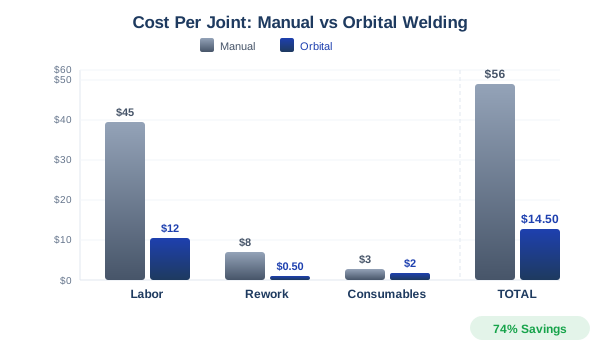
Cost Per Joint Breakdown Framework
Every weld joint has five cost components, whether it is welded manually or with an orbital system. Understanding each one is how you build an honest comparison.
| Cost Component | Manual GTAW | Orbital GTAW | Notes |
|---|---|---|---|
| Labor | $18--$45/joint | $8--$20/joint | Manual requires a certified welder at the torch for the full cycle. Orbital requires an operator for setup, then the machine welds autonomously. One orbital operator can manage 2--3 weld heads. |
| Equipment | $2--$5/joint | $5--$25/joint (amortized) | Manual TIG equipment is inexpensive. Orbital power supply + weld head = $30,000--$80,000+. Amortized cost drops rapidly with joint count. |
| Consumables | $3--$8/joint | $1--$4/joint | Manual uses more tungsten (frequent re-grinding), more filler rod, and more gas due to longer arc time. Orbital is autogenous (no filler) on most tube welds and uses tungsten more efficiently. |
| Shielding/Purge Gas | $2--$6/joint | $1--$3/joint | Manual welding has longer arc times and less efficient gas coverage. Orbital's enclosed head and shorter cycle time reduce gas consumption. See our gas coverage calculator. |
| Rework/Reject Cost | $15--$75/joint (applied to reject rate) | $1--$5/joint (applied to reject rate) | This is the hidden killer. Manual rework rates of 5--15% multiply across every joint. Orbital reject rates below 1% make rework a rounding error. |
Orbital vs. Manual: Cost Comparison by Joint Count
The following table compares total project cost for orbital vs. manual GTAW on 2" OD x 0.065" wall 316L sanitary tube. Assumes a pharmaceutical-grade application with borescope inspection and ASME BPE acceptance criteria.
Assumptions
| Parameter | Manual GTAW | Orbital GTAW |
|---|---|---|
| Welder/Operator rate (fully burdened) | $85/hour | $65/hour |
| Joints per hour | 3--4 | 8--12 |
| Reject/rework rate | 8% | 0.8% |
| Rework cost per joint | $55 | $55 |
| Equipment cost (amortized) | $3,000 (TIG rig) | $55,000 (power supply + weld head) |
| Equipment life (joints) | 10,000 | 10,000 |
| Consumables per joint | $5.50 | $2.25 |
| Gas per joint | $3.80 | $1.75 |
Total Project Cost Comparison
| Joint Count | Manual Total Cost | Orbital Total Cost | Orbital Savings | Savings % |
|---|---|---|---|---|
| 50 | $2,845 | $3,520 | -$675 | -24% (orbital costs more) |
| 100 | $5,540 | $4,790 | $750 | 14% |
| 200 | $10,930 | $7,330 | $3,600 | 33% |
| 500 | $27,025 | $15,650 | $11,375 | 42% |
| 1,000 | $53,900 | $28,800 | $25,100 | 47% |
| 2,000 | $107,650 | $55,100 | $52,550 | 49% |
How These Numbers Were Calculated
Manual cost per joint:
- Labor: $85/hr / 3.5 joints/hr = $24.29
- Equipment amortization: $3,000 / 10,000 = $0.30
- Consumables: $5.50
- Gas: $3.80
- Rework: 8% x $55 = $4.40
- Total: $38.29/joint
Orbital cost per joint (at 500 joints):
- Labor: $65/hr / 10 joints/hr = $6.50
- Equipment amortization: $55,000 / 10,000 = $5.50
- Consumables: $2.25
- Gas: $1.75
- Rework: 0.8% x $55 = $0.44
- Total: $16.44/joint
At low joint counts, orbital's higher equipment amortization makes it more expensive per joint. The crossover point is typically between 75 and 150 joints, depending on tube size and quality requirements.
Break-Even Analysis
The break-even point is where orbital's lower per-joint operating cost offsets its higher equipment investment. Here is the formula:
Break-Even Joints = Equipment Cost Difference / (Manual Cost Per Joint - Orbital Operating Cost Per Joint)
Using the numbers above:
- Equipment difference: $55,000 - $3,000 = $52,000
- Manual cost/joint: $38.29
- Orbital operating cost/joint (excluding equipment): $10.94
- Break-even: $52,000 / ($38.29 - $10.94) = 1,901 joints (to fully recover the purchase price)
However, this analysis changes dramatically if you are renting orbital equipment instead of buying.
Rental vs. Purchase Cost Modeling
For projects that do not justify a full equipment purchase, rental changes the economics significantly by eliminating the capital investment.
| Scenario | Purchase | Monthly Rental | Weekly Rental |
|---|---|---|---|
| Equipment cost | $55,000 (one-time) | $2,500--$4,500/month | $1,200--$2,000/week |
| 200-joint project (4 weeks) | $55,000 | $3,500 | $5,600 |
| 500-joint project (8 weeks) | $55,000 | $7,000 | $12,000 |
| 1,000-joint project (14 weeks) | $55,000 | $12,250 | N/A (switch to monthly) |
| Maintenance/repair | Your responsibility | Included | Included |
| Technology obsolescence | Your risk | None | None |
| Availability between projects | Sits idle | Return it | Return it |
Rental Break-Even vs. Manual
With rental equipment, the break-even point drops dramatically:
200-joint project on rental:
- Orbital total: $3,500 (rental) + 200 x $10.94 (operating) = $5,688
- Manual total: 200 x $38.29 = $7,658
- Savings: $1,970 (26%)
Rental makes orbital welding cost-effective on virtually any project above 50--75 joints.
The Hidden Costs of Manual Welding
The cost comparison tables above account for direct costs. But manual welding carries additional expenses that are harder to quantify but very real:
Rework Rate Impact
| Reject Rate | Rework Cost per 500 Joints | Rework Cost per 1,000 Joints |
|---|---|---|
| 1% (good orbital) | $275 | $550 |
| 3% (average orbital) | $825 | $1,650 |
| 5% (excellent manual) | $1,375 | $2,750 |
| 8% (average manual) | $2,200 | $4,400 |
| 12% (poor manual or difficult conditions) | $3,300 | $6,600 |
| 15% (high-purity manual, inexperienced welder) | $4,125 | $8,250 |
On a 1,000-joint pharmaceutical project, the difference between 1% and 8% reject rates is $3,850 in direct rework costs alone.
Additional Hidden Costs
| Hidden Cost | Manual GTAW Impact | Orbital GTAW Impact |
|---|---|---|
| Schedule delays from rework | Each rejected joint adds 20--30 minutes (cut out, re-prep, re-weld, re-inspect). At 8% reject rate on 1,000 joints, that is 27--40 hours of lost schedule time. | Minimal -- <1% reject rate means 2--3 rework events per 1,000 joints. |
| Welder fatigue | Quality degrades over long shifts. Reject rates climb in hours 6--10. Overtime costs increase. | Machine does not get tired. Quality is consistent from joint 1 to joint 1,000. |
| Welder availability | Certified sanitary welders command $85--$120/hour fully burdened and may not be available when you need them. | Orbital operators require less specialized skill. Certification training takes 2--3 days vs. months for manual certification. |
| Documentation burden | Each manual weld requires operator-recorded parameters. Errors in documentation can trigger re-inspection or rejection by the owner's QC. | Orbital power supplies log parameters automatically -- amperage, time, RPM, gas flow. Digital weld logs reduce documentation labor by 50--75%. |
| Repeatability risk | Two different welders produce different results. Weld quality depends on the individual. | Every joint is welded with identical parameters. Process capability (Cpk) is inherently higher. |
ROI Calculation Example
Scenario: A mechanical contractor bids 3 pharmaceutical projects per year, averaging 400 tube weld joints each (1,200 joints/year). Currently using manual GTAW.
Current Annual Cost (Manual)
| Item | Calculation | Annual Cost |
|---|---|---|
| Labor (welders) | 1,200 joints / 3.5 joints/hr x $85/hr | $29,143 |
| Consumables | 1,200 x $5.50 | $6,600 |
| Gas | 1,200 x $3.80 | $4,560 |
| Rework (8%) | 96 joints x $55 | $5,280 |
| Equipment depreciation | $3,000 / 5 years | $600 |
| Total | $46,183 |
Projected Annual Cost (Orbital -- Equipment Purchase)
| Item | Calculation | Annual Cost |
|---|---|---|
| Labor (operators) | 1,200 joints / 10 joints/hr x $65/hr | $7,800 |
| Consumables | 1,200 x $2.25 | $2,700 |
| Gas | 1,200 x $1.75 | $2,100 |
| Rework (0.8%) | 10 joints x $55 | $550 |
| Equipment depreciation | $55,000 / 7 years | $7,857 |
| Training | $3,000 / 3 years | $1,000 |
| Maintenance | $2,000/year | $2,000 |
| Total | $24,007 |
ROI Summary
| Metric | Value |
|---|---|
| Annual savings | $22,176 |
| Equipment investment | $55,000 |
| Payback period | 2.5 years |
| 5-year ROI | 102% |
| 7-year ROI (equipment life) | 182% |
And this does not account for the schedule savings, reduced QC burden, or the ability to bid more competitively against competitors who have already gone orbital.
When Does Orbital NOT Make Sense?
Orbital welding is not always the answer. Consider manual GTAW when:
- Joint count is very low (<50 joints) and you do not have orbital equipment available
- Access is severely restricted -- some field conditions do not allow weld head installation
- Joint geometry varies -- non-standard joints, branch connections, or saddle welds that a standard orbital head cannot reach
- Material is exotic and untested -- developing an orbital schedule for a new alloy may take more time than manual welding the joints
For projects in the gray zone (50--200 joints), renting orbital equipment eliminates the capital barrier and makes the decision easy.
Build Your Own Estimate
Use this framework to calculate cost per joint for your specific project:
- Determine your labor rate (fully burdened: wages + benefits + overhead)
- Estimate joints per hour (by tube size and application -- smaller tube = faster)
- Get actual consumable costs from your supplier
- Calculate gas cost using our gas coverage calculator
- Estimate your reject rate honestly (pull historical QC data if available)
- Amortize equipment over realistic joint count or project life
- Add rework cost: reject rate x (labor to cut out + re-prep + re-weld + re-inspect)
The numbers do not lie. Run them for your situation.
Ready to Run the Numbers for Your Project?
TechSouth provides orbital welding equipment sales and rental, operator training and certification, and project support. Whether you need a rental quote for a 200-joint project or want to evaluate a purchase for your shop, contact us for a project-specific cost analysis.
Get the Orbital Welding Reference Pack
Sizing charts, grinding angle tables, and purge flow rates — all in one printable PDF.
No spam. Unsubscribe anytime.
Ready to get started? TechSouth Inc. carries the equipment mentioned in this guide.
Request Rental from TechSouthRelated Guides
Orbital Welding Equipment Rental Guide
Everything you need to know about renting orbital welding equipment. When to rent vs buy, what's included, and how to get started with TechSouth rentals.
Orbital Welding Certification Requirements Explained
What you need to know about orbital welding certification. Covers ASME Section IX, operator qualification, procedure qualification, and training paths.