Purge Plug Sizing Chart for Tube and Pipe Welding
Complete purge plug sizing chart for tube and pipe welding. Find the right inflatable purge plug size by OD, ID, and wall thickness.
Quick Reference
This chart maps common tube OD sizes and pipe nominal sizes to the correct inflatable purge plug size for weld purging. Use it to select plugs that seal the tube or pipe ID, creating an inert atmosphere at the weld joint to prevent oxidation and discoloration on the root side of the weld. The plug size is based on the inside diameter of the tube or pipe, not the outside diameter. Always verify ID by measuring or calculating from OD minus two times wall thickness.
Tube Purge Plug Sizing Chart
Tube is specified by outside diameter (OD) and wall thickness. The ID determines the purge plug size. The following chart covers common stainless steel tubing sizes used in orbital welding for pharmaceutical, semiconductor, food and beverage, and general process applications.
| Tube OD | Common Wall | Calculated ID | Purge Plug Size |
|---|---|---|---|
| 1/4" (6.35 mm) | 0.035" (0.89 mm) | 0.180" (4.57 mm) | 3/16" - 1/4" plug |
| 3/8" (9.53 mm) | 0.035" (0.89 mm) | 0.305" (7.75 mm) | 5/16" - 3/8" plug |
| 1/2" (12.70 mm) | 0.049" (1.24 mm) | 0.402" (10.21 mm) | 3/8" - 1/2" plug |
| 3/4" (19.05 mm) | 0.065" (1.65 mm) | 0.620" (15.75 mm) | 5/8" - 3/4" plug |
| 1" (25.40 mm) | 0.065" (1.65 mm) | 0.870" (22.10 mm) | 7/8" - 1" plug |
| 1-1/2" (38.10 mm) | 0.065" (1.65 mm) | 1.370" (34.80 mm) | 1-3/8" - 1-1/2" plug |
| 2" (50.80 mm) | 0.065" (1.65 mm) | 1.870" (47.50 mm) | 1-7/8" - 2" plug |
| 2-1/2" (63.50 mm) | 0.065" (1.65 mm) | 2.370" (60.20 mm) | 2-3/8" - 2-1/2" plug |
| 3" (76.20 mm) | 0.065" (1.65 mm) | 2.870" (72.90 mm) | 2-7/8" - 3" plug |
| 4" (101.60 mm) | 0.083" (2.11 mm) | 3.834" (97.38 mm) | 3-3/4" - 4" plug |
Note: Wall thickness varies by specification. ASME BPE tubing commonly uses the wall thicknesses listed above, but always verify the actual wall thickness of your material. Different wall thickness means a different ID and potentially a different plug size.
Pipe Purge Plug Sizing Chart
Pipe is specified by Nominal Pipe Size (NPS), which does not directly correspond to any physical measurement. The actual OD is standardized, and the ID varies by schedule (wall thickness). The following chart covers common stainless steel pipe sizes in Schedule 10S and Schedule 40S, which are the most frequently encountered in orbital welding applications.
| NPS | Pipe OD | Schedule 10S Wall | Sch 10S ID | Plug Size (Sch 10S) | Schedule 40S Wall | Sch 40S ID | Plug Size (Sch 40S) |
|---|---|---|---|---|---|---|---|
| 1/2" | 0.840" | 0.083" | 0.674" | 5/8" - 3/4" plug | 0.109" | 0.622" | 5/8" - 3/4" plug |
| 3/4" | 1.050" | 0.083" | 0.884" | 7/8" - 1" plug | 0.113" | 0.824" | 3/4" - 7/8" plug |
| 1" | 1.315" | 0.109" | 1.097" | 1" - 1-1/8" plug | 0.133" | 1.049" | 1" - 1-1/8" plug |
| 1-1/2" | 1.900" | 0.109" | 1.682" | 1-5/8" - 1-3/4" plug | 0.145" | 1.610" | 1-1/2" - 1-5/8" plug |
| 2" | 2.375" | 0.109" | 2.157" | 2-1/8" - 2-1/4" plug | 0.154" | 2.067" | 2" - 2-1/8" plug |
| 3" | 3.500" | 0.120" | 3.260" | 3-1/4" - 3-3/8" plug | 0.216" | 3.068" | 3" - 3-1/8" plug |
| 4" | 4.500" | 0.120" | 4.260" | 4-1/4" - 4-3/8" plug | 0.237" | 4.026" | 4" - 4-1/8" plug |
| 6" | 6.625" | 0.134" | 6.357" | 6-1/4" - 6-3/8" plug | 0.280" | 6.065" | 6" - 6-1/8" plug |
| 8" | 8.625" | 0.148" | 8.329" | 8-1/4" - 8-3/8" plug | 0.322" | 7.981" | 8" plug |
Critical point: A "2-inch pipe" has an OD of 2.375", while a "2-inch tube" has an OD of exactly 2.000". These are not interchangeable. Using a purge plug sized for 2" tube inside 2" NPS pipe will leave a loose, leaking seal because the pipe ID is significantly larger than the tube ID. Always know whether you are working with tube or pipe, and size accordingly.
How to Read This Chart
- Identify whether you are working with tube or pipe. Tube is specified by OD. Pipe is specified by NPS. If your drawing says "2 inch OD," it is tube. If it says "2 inch NPS" or "2 inch Schedule 10," it is pipe.
- Determine the wall thickness. Check the material specification, purchase order, or measure the wall directly with calipers.
- Calculate the ID. For tube: ID = OD - (2 x wall thickness). For pipe: use the chart above, or calculate the same way from the actual OD and wall.
- Select the plug size. Choose a plug whose expansion range covers your calculated ID. The plug must expand enough to seal against the pipe or tube wall, but not be so oversized that it cannot be inserted or does not fully inflate.
Example: You are orbital welding 1" OD x 0.065" wall stainless steel tube. ID = 1.000" - (2 x 0.065") = 0.870". Select a purge plug rated for approximately 7/8" to 1" ID range.
Why Proper Purging Matters
The root side of a weld joint must be shielded from atmospheric oxygen and nitrogen during welding. Without purging, the molten weld pool on the inside of the tube or pipe reacts with oxygen, causing:
- Oxidation and discoloration (heat tint). Even mild discoloration indicates an oxide layer that compromises corrosion resistance in stainless steel. In pharmaceutical and semiconductor applications, ASME BPE specifies acceptable heat tint levels, and anything beyond a light straw color (measured on the Swagelok or AWS color scale) is cause for rejection.
- Sugaring. Heavy oxidation produces a rough, granular deposit of chromium oxide on the root side. Sugaring creates crevices that harbor bacteria in sanitary systems, resist passivation, and act as stress concentration points. Sugared welds are always rejected in high-purity work and are structurally compromised in any application.
- Loss of corrosion resistance. Chromium in stainless steel provides corrosion resistance by forming a passive chromium oxide layer. When chromium is consumed by heavy oxidation during welding, the chromium-depleted zone adjacent to the weld becomes susceptible to intergranular corrosion, pitting, and premature failure.
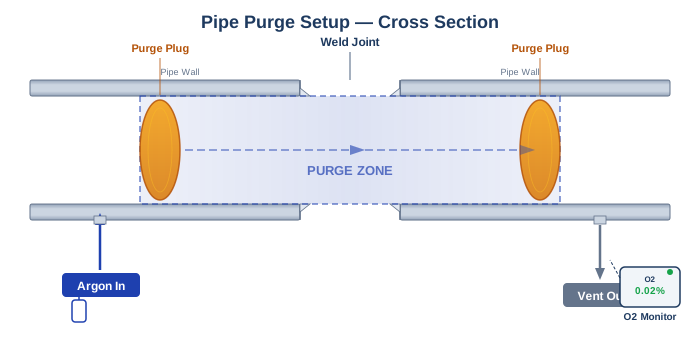
Purge plugs create a sealed zone around the weld joint, allowing inert gas (typically argon, sometimes a 95/5 argon/hydrogen mix) to displace atmospheric gases before and during welding.
Purge Gas Flow Rate Guidelines
Proper purge plug sizing is only half the equation. Gas flow rate and pre-purge time must be adequate to reduce oxygen levels inside the sealed zone before welding begins.
Recommended Flow Rates by Tube/Pipe Size
| Tube/Pipe ID Range | Purge Gas Flow Rate | Pre-Purge Time (minimum) |
|---|---|---|
| Under 1/2" ID | 5-10 CFH (2.4-4.7 L/min) | 30-60 seconds |
| 1/2" to 1" ID | 10-20 CFH (4.7-9.4 L/min) | 45-90 seconds |
| 1" to 2" ID | 15-25 CFH (7.1-11.8 L/min) | 60-120 seconds |
| 2" to 4" ID | 20-35 CFH (9.4-16.5 L/min) | 90-180 seconds |
| 4" to 8" ID | 30-50 CFH (14.2-23.6 L/min) | 120-300 seconds |
These are starting points. The enclosed volume between the two purge plugs, the leak rate of the seals, and the target oxygen level all affect the actual time and flow needed. For critical high-purity work, use an oxygen analyzer to verify the purge atmosphere has reached the required level -- typically below 50 ppm for ASME BPE, and often below 10 ppm for semiconductor gas systems -- before initiating the weld.
Purge Tips for Consistent Results
- Place plugs 4-6 inches from each side of the weld joint. Too close, and the heat may damage the plug. Too far, and the enclosed volume increases, requiring more gas and longer pre-purge time.
- Use a slight positive pressure, not high flow. The goal is displacement, not pressurization. Excessive flow can cause turbulence that pulls in atmospheric air rather than pushing it out.
- Vent the purge zone. The enclosed space between the plugs needs a vent path for displaced air to escape as argon fills the zone. Many inflatable plugs include a vent hole or channel. If yours does not, leave a slight gap or use a plug with an integrated vent tube.
- Maintain the purge through the entire weld and cooldown. Do not cut the gas as soon as the weld arc stops. Keep purge gas flowing until the weld has cooled below approximately 500 degrees F (260 degrees C), where oxidation rates become negligible.
- Inspect plug condition before every use. Inflatable plugs wear out. A plug with a pinhole leak will not hold purge, and you may not realize it until you see discoloration after welding. Replace plugs that show cuts, abrasion, or that do not hold inflation.
Recommended Equipment
For guidance on the differences between tube and pipe sizing, see the Orbital Welding: Pipe vs Tube Guide. For tungsten preparation that complements proper purging, see the Tungsten Electrode Grinding Angle Chart.
Get the Orbital Welding Reference Pack
Sizing charts, grinding angle tables, and purge flow rates — all in one printable PDF.
No spam. Unsubscribe anytime.
Ready to get started? TechSouth Inc. carries the equipment mentioned in this guide.
Shop Equipment at TechSouthRelated Guides
Orbital Welding: Pipe vs Tube — Key Differences Explained
Understand the critical differences between pipe and tube orbital welding. Covers sizing, weld head selection, joint prep, and parameter differences.
Tungsten Electrode Grinding Angle Chart & Guide
Quick-reference tungsten electrode grinding angle chart. Covers recommended angles by application, material thickness, and welding process (TIG, orbital).