Tungsten Electrode Grinding Angle Chart & Guide
Quick-reference tungsten electrode grinding angle chart. Covers recommended angles by application, material thickness, and welding process (TIG, orbital).
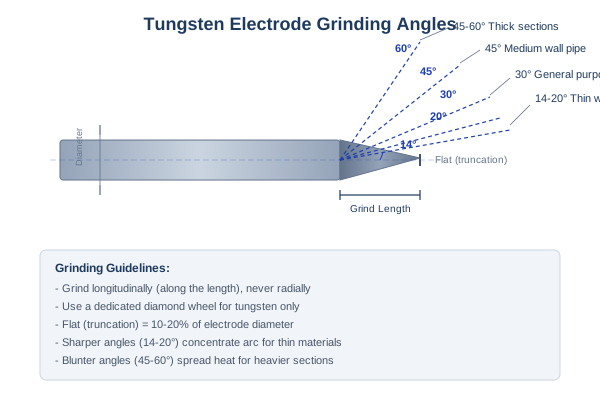
Quick Reference
This chart covers tungsten electrode included-angle recommendations for GTAW (TIG) and orbital welding applications. The included angle is the total angle of the tapered point — measured across the full taper, not from one side to the centerline. A 30-degree included angle means each side tapers 15 degrees from the electrode centerline.
Use these recommendations as starting points. Final angle selection depends on your specific joint geometry, material, amperage range, and arc stability requirements. All angles assume proper longitudinal grinding technique.
Grinding Angle Chart by Application
| Included Angle | Taper Length (on 3/32" electrode) | Arc Shape | Penetration Profile | Best Applications |
|---|---|---|---|---|
| 14° | ~0.375" (long taper) | Very wide, soft arc | Shallow, wide bead | Ultra-thin wall tube (0.020"–0.035"), foil welding, orbital fusion welds on thin sanitary tube |
| 18–20° | ~0.290" | Wide, stable arc | Moderate width, shallow penetration | Thin-wall sanitary tube (0.035"–0.065"), orbital autogenous welds, semiconductor tube |
| 30° | ~0.180" | Moderate width | Balanced width and penetration | General-purpose TIG on sheet and thin plate (16–11 ga), orbital welds on medium-wall tube |
| 45° | ~0.115" | Focused arc | Deeper, narrower penetration | Pipe welding (Sch 10–40), plate joints, filler wire applications, root passes on groove welds |
| 60° | ~0.080" (short taper) | Tight, concentrated arc | Deep, narrow penetration | Heavy pipe (Sch 80+), thick plate, high-amperage applications (150 A+), deep groove welds |
Recommended Angles by Material Thickness
| Material Thickness | Recommended Angle | Electrode Diameter | Typical Amperage Range |
|---|---|---|---|
| 0.020" – 0.035" (foil/ultra-thin) | 14° – 18° | 0.040" or 1/16" | 5 – 20 A |
| 0.035" – 0.049" (thin-wall tube) | 18° – 20° | 1/16" or 3/32" | 15 – 35 A |
| 0.049" – 0.065" (sanitary tube) | 18° – 25° | 3/32" | 25 – 50 A |
| 0.065" – 0.109" (medium wall) | 25° – 35° | 3/32" or 1/8" | 40 – 90 A |
| 0.120" – 0.154" (Sch 10–40 pipe) | 30° – 45° | 3/32" or 1/8" | 60 – 130 A |
| 0.218"+ (Sch 80+ pipe, plate) | 45° – 60° | 1/8" or 5/32" | 100 – 250 A |
Electrode Types and Color Codes
Not all tungsten electrodes are the same. The alloying oxide affects arc starting, arc stability, current capacity, and electrode life. Here are the types you will encounter:
| Type | AWS Class | Color Code | Oxide Content | Key Characteristics |
|---|---|---|---|---|
| Pure Tungsten | EWP | Green | None | AC welding on aluminum only. Poor arc starting on DC. Balls up at the tip. Rarely used for steel. |
| 2% Thoriated | EWTh-2 | Red | 2% ThO2 | Excellent arc stability and starting on DC. Long life. Industry standard for decades. Mildly radioactive — grinding produces hazardous dust. Being phased out in many shops. |
| 2% Ceriated | EWCe-2 | Gray (orange in some systems) | 2% CeO2 | Good arc starting at low amperages. Works on DC and AC. Non-radioactive. Preferred replacement for thoriated in low-to-medium amperage work including orbital welding. |
| 1.5% Lanthanated | EWLa-1.5 | Gold | 1.5% La2O3 | Similar performance to thoriated. Good across a wide amperage range. Non-radioactive. Gaining popularity as a direct thoriated replacement. |
| 2% Lanthanated | EWLa-2 | Blue | 2% La2O3 | Slightly higher oxide content than 1.5%. Marginally better arc starting. Also non-radioactive. |
| Rare Earth Blend | EWG | Various (often purple or multi-stripe) | Mixed rare earth oxides | Proprietary blends. Performance varies by manufacturer. Some are excellent general-purpose electrodes. |
For orbital welding on stainless steel sanitary tube, 2% ceriated (gray) or 1.5%/2% lanthanated (gold/blue) are the standard choices. They start cleanly at low amperages, maintain a stable arc during pulsing, and do not carry the regulatory burden of thoriated tungsten.
For general shop TIG welding across a range of materials and amperages, 2% lanthanated is the most versatile single electrode type.
For a detailed comparison of tungsten grinder options to prepare these electrodes, see our Tungsten Grinder Buying Guide.
How Grinding Angle Affects Arc Characteristics
The relationship between included angle and arc behavior is straightforward:
Narrower angle (longer taper, e.g., 14°–20°):
- Produces a wider, more diffused arc cone
- Lower current density at the tip
- Shallower penetration across a wider area
- More stable at low amperages
- Better for thin materials where burn-through is a risk
- Tip is more fragile and more likely to contaminate if it contacts the weld pool
Wider angle (shorter taper, e.g., 45°–60°):
- Produces a tighter, more focused arc cone
- Higher current density at the tip
- Deeper, narrower penetration
- Handles higher amperages before the tip overheats
- More robust tip — less likely to break off or erode
- Can be harder to start at very low amperages
This is not arbitrary — it follows from physics. The taper geometry concentrates or spreads the electron emission area at the electrode tip, which directly controls the arc cone width and energy distribution.
Flat Tip (Truncation) Recommendations
After grinding the taper, many welding procedures call for grinding or breaking off the sharp tip to create a small flat. This flat (also called a truncation or tip flat) improves arc stability and electrode life by preventing the sharp tip from overheating and eroding into the weld pool.
Recommended flat diameter by electrode size:
| Electrode Diameter | Recommended Flat | Notes |
|---|---|---|
| 0.040" | 0.005" – 0.010" | Micro-flat — just break the point |
| 1/16" (0.0625") | 0.010" – 0.015" | Standard for thin-wall orbital |
| 3/32" (0.094") | 0.010" – 0.020" | Most common orbital size |
| 1/8" (0.125") | 0.015" – 0.030" | General TIG and orbital |
| 5/32" (0.156") | 0.020" – 0.040" | Heavy-wall pipe and plate |
For orbital welding, a consistent flat is particularly important because the automated process cannot compensate for a wandering arc caused by an inconsistent tip. Many orbital welding power supplies include a tungsten preparation specification in the weld schedule — follow it.
Grinding Technique: Longitudinal, Not Radial
This is non-negotiable: grind the tungsten lengthwise (longitudinally), with the grinding marks running parallel to the electrode axis. Do not grind across the electrode (radially).
Why it matters:
- Longitudinal grind lines channel the arc straight off the tip, producing a stable, symmetrical arc cone.
- Radial grind lines (across the electrode) create micro-ridges that cause the arc to wander and deflect unpredictably. The arc follows the grind marks.
- On orbital welds, arc wander from improper grinding shows up as inconsistent bead width and penetration around the circumference — exactly the kind of defect a borescope inspection will catch.
A dedicated tungsten grinder with a diamond wheel produces consistent longitudinal grinds with repeatable angles. Grinding tungsten on a bench grinder or belt sander produces inconsistent angles, radial grind marks, and (with thoriated tungsten) airborne radioactive particulate. A proper grinder pays for itself in electrode consistency and safety.
Shop Tungsten Grinders at TechSouth
Relevant Standards and Specifications
- AWS A5.12/A5.12M — Specification for Tungsten and Oxide Dispersed Tungsten Electrodes for Arc Welding and Cutting. Defines electrode classifications, color codes, and chemical composition.
- AWS D18.1 — Specification for Welding of Austenitic Stainless Steel Tube and Pipe Systems in Sanitary (Hygienic) Applications. References tungsten preparation requirements for sanitary welding.
- ASME BPE — Bioprocessing Equipment standard. Specifies weld acceptance criteria for high-purity systems. Does not prescribe tungsten angles directly but the weld quality requirements drive angle selection toward the narrow-angle end for thin-wall tube work.
- ASME Section IX — Welding, Brazing, and Fusing Qualifications. Tungsten electrode type and preparation are typically recorded as essential or supplementary essential variables in WPS/PQR documentation.
Most orbital welding equipment manufacturers also publish recommended tungsten preparations (angle, flat, electrode type, diameter) for each weld head and material combination. Check your equipment manual first — those recommendations have been validated by the manufacturer's application engineering team.
Recommended Equipment
Consistent tungsten preparation requires a dedicated grinder. Hand-grinding on a bench wheel does not produce repeatable angles or proper longitudinal grind patterns.
- Shop Tungsten Grinders at TechSouth — We carry benchtop and portable tungsten grinders with adjustable angle settings, diamond wheels, and dust collection for safe grinding of all electrode types including thoriated.
- Shop Tungsten Electrodes at TechSouth — Ceriated, lanthanated, thoriated, and pure tungsten in standard diameters.
For help selecting the right grinder or electrode type for your application, see our Tungsten Grinder Buying Guide or contact TechSouth directly.
Get the Orbital Welding Reference Pack
Sizing charts, grinding angle tables, and purge flow rates — all in one printable PDF.
No spam. Unsubscribe anytime.
Ready to get started? TechSouth Inc. carries the equipment mentioned in this guide.
Shop Equipment at TechSouthRelated Guides
Tungsten Grinder Buying Guide: How to Choose the Right One
Compare tungsten grinders for orbital and TIG welding. Covers key features, grinding angles, dust collection, and top picks for professional welders.
Orbital Welding: Pipe vs Tube — Key Differences Explained
Understand the critical differences between pipe and tube orbital welding. Covers sizing, weld head selection, joint prep, and parameter differences.