Tungsten Grinder Buying Guide: How to Choose the Right One
Compare tungsten grinders for orbital and TIG welding. Covers key features, grinding angles, dust collection, and top picks for professional welders.
Why Consistent Tungsten Prep Matters for Weld Quality
A tungsten grinder is a dedicated tool that sharpens and profiles the tip of a tungsten electrode to a precise geometry before TIG or orbital welding. It sounds simple, but tungsten preparation is one of the most underestimated variables in weld quality. The shape, angle, and surface finish of the electrode tip directly control arc characteristics: how the arc starts, how it focuses, and how stable it remains throughout the weld.
In manual TIG welding, a skilled welder can sometimes compensate for a poorly prepped electrode by adjusting technique on the fly. In orbital welding, there is no such safety net. The power supply executes a programmed schedule, and the arc must behave predictably from start to finish. An electrode ground with inconsistent geometry or a rough surface finish will cause arc wander, uneven penetration, and erratic bead profiles. On critical piping systems in pharmaceutical, semiconductor, or food-grade applications, that kind of inconsistency means failed inspections and rework.
Hand grinding tungsten on a bench grinder is how most welders start, but it introduces several problems that a purpose-built tungsten grinder eliminates. Understanding those problems, and the features that solve them, is the core of making a smart purchasing decision.
Hand Grinding vs. Dedicated Tungsten Grinder
Before evaluating specific grinders, it helps to understand what you are replacing and why.
The Bench Grinder Problem
Grinding tungsten on a standard bench grinder or belt sander seems to work. The electrode gets sharp. But several issues compound over time:
- Inconsistent angles. Holding a 1/16" or 3/32" electrode freehand against a spinning wheel and maintaining a precise 18-degree included angle is nearly impossible. Angles vary from electrode to electrode and even along a single grind.
- Longitudinal grind lines. A proper tungsten grind produces lines running lengthwise along the electrode, parallel to its axis. Freehand grinding on a bench wheel naturally produces circumferential grind lines, which act as micro-ridges that cause the arc to wander unpredictably.
- Contamination. Bench grinder wheels used for other materials embed steel, aluminum, or other particles in the grinding surface. Those contaminants transfer into the tungsten and vaporize in the arc, introducing inclusions into the weld.
- Tungsten dust exposure. Thoriated tungsten (2% ThO2) contains low-level radioactive thorium oxide. Grinding it without dust collection creates an inhalation hazard. Even with non-thoriated varieties like ceriated or lanthanated, fine tungsten dust is not something you want in your lungs.
What a Dedicated Grinder Solves
A purpose-built tungsten grinder addresses every one of these issues. It holds the electrode in a fixed collet, rotates it against a diamond grinding surface at a set angle, produces longitudinal grind lines by design, uses a dedicated wheel that never touches other materials, and captures dust at the source. The result is repeatable electrode geometry, every time, with no operator skill required.
Key Features to Evaluate
Grinding Surface: Diamond Wheel vs. Diamond Disc vs. Belt
Most professional tungsten grinders use a diamond-coated wheel or disc. Diamond cuts tungsten carbide cleanly and lasts a long time before replacement. Some economy models use abrasive belts instead. Belts are cheaper to replace but wear faster, produce a rougher surface finish, and require more frequent changes. For orbital welding applications or any work where consistency matters, a diamond wheel is the standard.
Look for diamond wheels with a grit rating between 200 and 600. Coarser grits (200) remove material faster for initial shaping; finer grits (400-600) produce a smoother surface finish that improves arc stability.
Angle Adjustment Range
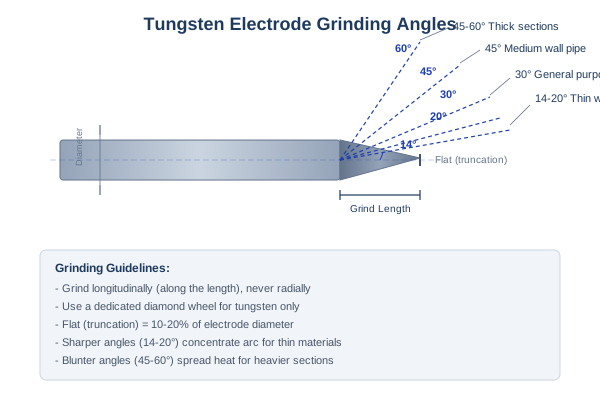
The included angle of the tungsten tip determines arc focus. Sharper angles (14-20 degrees included) produce a narrow, concentrated arc suited for thin wall tube welding and low-amperage orbital work. Wider angles (30-60 degrees included) spread the arc for higher amperage applications and thicker materials.
A good grinder offers adjustable angle settings, typically from 15 to 60 degrees in increments. Some models use detent stops at common angles (20, 30, 45, 60 degrees), while others allow continuously variable adjustment. Detent stops are faster for shops that use a few standard angles. Variable adjustment gives more flexibility for specialized applications.
For orbital welding, most tube work calls for an 18-20 degree included angle. Pipe welding with open root joints typically uses 20-30 degrees. Make sure the grinder you select covers the angles your work requires.
Electrode Diameter Range
Tungsten electrodes come in standard diameters from 0.020" (0.5 mm) up to 1/4" (6.35 mm). Orbital tube welding commonly uses 1/16" (1.6 mm) and 3/32" (2.4 mm) electrodes. Pipe orbital welding may go up to 1/8" (3.2 mm) or 5/32" (4.0 mm).
The grinder must accept collets or fixtures that hold each diameter you use. Check what collet sizes ship with the grinder and what sizes are available as accessories. Some grinders include a full collet set; others include only a few common sizes with the rest sold separately.
Dust Collection
Any grinder worth buying for professional use includes some form of dust collection. This is not optional. At minimum, look for an enclosed grinding chamber with a vacuum port or integrated dust filter. Better models include a built-in vacuum or HEPA-grade filtration.
If you are grinding thoriated tungsten, proper dust collection is a regulatory and health requirement. Even if you have transitioned to ceriated (gray stripe) or lanthanated (gold/blue stripe) electrodes, dust containment keeps your workspace clean and extends the life of the grinding surface.
Flat and Offset Grinds
Standard tungsten grinders produce a centered point. Some applications, particularly orbital tube welding on very small diameters (1/4" to 1/2" OD), benefit from an offset grind where the tip is ground slightly off-center. This allows the electrode to sit closer to the weld joint in tight-clearance weld heads. Not every grinder supports this. If your work includes small-bore orbital welding, check whether the grinder offers an offset grinding capability or accessory.
Portability and Power
Tungsten grinders range from compact, battery-powered units designed for field use to heavier benchtop models built for high-volume shop work. Consider where you will use the grinder most. Field service technicians and traveling pipe welders need something that fits in a tool bag and runs on a rechargeable battery. A fabrication shop that preps dozens of electrodes per day benefits from a benchtop unit with a more powerful motor and larger diamond wheel.
Tip Cutting and Length Setting
Some grinders include a built-in feature for cutting the tungsten to length or trimming a contaminated tip before regrinding. This saves time compared to scoring and snapping or using a separate cut-off wheel. It is a convenience feature rather than a necessity, but it adds value in high-throughput environments.
Top Picks for Professional Welders
Compact Field Grinder
For welders who need portability above all else, a compact handheld grinder with a diamond disc, integrated dust cap, and collets for 1/16" through 1/8" electrodes covers most field TIG and orbital welding needs. These units typically run on AC power or a rechargeable battery, weigh under 3 lbs, and fit in a weld head carry case.
Best for: Traveling orbital welders, field service, maintenance work.
Mid-Range Shop Grinder
A benchtop grinder with a 2" to 3" diamond wheel, adjustable angle stops, full collet set (0.040" through 1/4"), and a built-in dust collection chamber is the workhorse choice for most fabrication shops. These grinders handle the full range of electrode sizes and angles, grind quickly, and produce consistent results shift after shift.
Best for: Fabrication shops, piping contractors, multi-process TIG environments.
High-Volume Production Grinder
For shops that prep large quantities of electrodes, models with automatic feed, programmable angle settings, and high-capacity dust filtration reduce cycle time and operator involvement. These are overkill for occasional use but pay for themselves in high-production orbital welding environments such as semiconductor fab and pharmaceutical piping.
Best for: High-purity piping contractors, semiconductor fabs, pharma facilities.
Comparison Table
| Feature | Compact Field | Mid-Range Shop | High-Volume Production |
|---|---|---|---|
| Diamond Wheel Size | 1"-2" disc | 2"-3" wheel | 3"+ wheel |
| Angle Range | 15-45 deg | 15-60 deg | 15-60 deg, programmable |
| Electrode Diameters | 1/16" - 1/8" | 0.040" - 1/4" | 0.040" - 1/4" |
| Dust Collection | Cap/filter | Enclosed chamber | HEPA vacuum system |
| Power | Battery or AC | AC | AC |
| Weight | 1-3 lbs | 5-15 lbs | 15-30 lbs |
| Price Range | $300 - $700 | $700 - $1,500 | $1,500 - $4,000+ |
| Best For | Field/travel | General shop use | High-output production |
How to Choose: Decision Guide
Start with three questions:
Where will you use it most? If the answer is job sites, confined spaces, or alongside portable orbital welding equipment, size and weight matter more than maximum capacity. Go compact. If it will live on a shop bench, prioritize grinding wheel size and angle range.
What electrode diameters do you run? If you exclusively weld small-bore tube with 1/16" and 3/32" electrodes, a compact grinder covers you. If your work spans thin-wall tube through heavy-wall pipe and you use electrodes from 0.040" to 3/16", you need a mid-range or production unit with the full collet range.
How many electrodes do you prep per day? Occasional use (a few per shift) does not justify a production-grade grinder. If you are running multiple orbital weld heads and prepping 20 or more electrodes per day, the speed and consistency of a higher-end model will save real time and reduce scrap from weld defects caused by worn or inconsistent tips.
For most orbital welding contractors and fabrication shops, a mid-range benchtop grinder with adjustable angles, a full collet set, and proper dust collection hits the right balance of capability, consistency, and cost. It handles everything from thin-wall sanitary tube to moderate pipe sizes and will last years with basic diamond wheel maintenance.
The Bottom Line
Tungsten preparation is not glamorous, but it is foundational. Every weld starts with the electrode, and every electrode starts with the grind. A $30 tungsten electrode ground carelessly on a contaminated bench wheel will underperform a $3 electrode prepped on a proper grinder with the correct angle and a clean longitudinal finish.
For orbital welding in particular, where repeatability is the entire point, investing in a dedicated tungsten grinder is one of the highest-return equipment decisions you can make. It removes a variable from your process, reduces arc-related defects, and pays for itself in avoided rework.
Shop Tungsten Grinders at TechSouth
For help selecting the right angle for your application, see the Tungsten Electrode Grinding Angle Chart.
Get the Orbital Welding Reference Pack
Sizing charts, grinding angle tables, and purge flow rates — all in one printable PDF.
No spam. Unsubscribe anytime.
Ready to get started? TechSouth Inc. carries the equipment mentioned in this guide.
Shop Equipment at TechSouthRelated Guides
Tungsten Electrode Grinding Angle Chart & Guide
Quick-reference tungsten electrode grinding angle chart. Covers recommended angles by application, material thickness, and welding process (TIG, orbital).
Orbital Welding: Pipe vs Tube — Key Differences Explained
Understand the critical differences between pipe and tube orbital welding. Covers sizing, weld head selection, joint prep, and parameter differences.