Weld Purge Oxygen Monitoring: Equipment & Best Practices
Guide to weld purge oxygen monitoring. Covers O2 analyzer types, acceptable oxygen levels by application, calibration, and monitoring best practices.
Why You Cannot Trust Your Eyes
Here is a fact that catches people off guard: a stainless steel weld can look perfectly acceptable -- light straw to gold color on the backside -- and still have been made at an oxygen level high enough to compromise corrosion resistance.
Weld color is a rough indicator. A bright silver ID indicates very low oxygen. Heavy blue or black oxide tells you something went badly wrong. But the colors in between -- the straws, the light blues, the golds -- do not map reliably to a specific oxygen concentration. Two welds with identical heat tint can have been purged to 50 ppm and 500 ppm respectively, depending on temperature, gas flow dynamics, and how quickly the weld cooled.
This is why oxygen monitoring exists. It removes the guesswork and gives you a number. In critical applications -- pharmaceutical, semiconductor, nuclear, food and beverage -- that number is a documented requirement, not a suggestion. Even in general stainless fabrication, monitoring your purge gas means fewer rejected welds, less rework, and more consistent results.
This guide covers the equipment, technique, and standards for weld purge oxygen monitoring. For purge setup fundamentals, see our Argon Purge Welding Guide.
What You Need
- Oxygen analyzer (electrochemical or zirconia sensor -- see below)
- Sample tubing (typically 1/4" OD nylon or PTFE)
- Sample draw pump (built into most analyzers, or external)
- Calibration gas (certified zero gas and/or span gas)
- Purge dams or plugs (sizing guide here)
- Purge gas supply (argon, typically 99.996% or better purity)
Types of Oxygen Analyzers
Two sensor technologies dominate weld purge monitoring. Each has distinct strengths.
Electrochemical Sensors
How they work: A galvanic cell generates a small electrical current proportional to the oxygen concentration in the sample gas. The current is measured and displayed as a ppm or percent reading.
Pros:
- Lower cost ($500 - $2,500 typical)
- Good accuracy across a wide range (0.01% to 25%)
- No warm-up time -- reads immediately on power-up
- Compact and portable
- Battery powered options available for field use
Cons:
- Sensor has a finite lifespan (typically 12 to 24 months), regardless of use
- Accuracy degrades as the sensor ages -- requires periodic calibration checks
- Response time is slower than zirconia (several seconds to stabilize)
- Exposure to high O2 concentrations accelerates sensor consumption
Best for: General fabrication, field work, shops running stainless at moderate purge requirements (under 100 ppm target). Most welders' first purge monitor uses an electrochemical sensor.
Zirconia Sensors
How they work: A zirconia ceramic element is heated to approximately 650 degrees C. At this temperature, the ceramic becomes an oxygen ion conductor. The voltage difference between the sample gas side and a reference gas side is proportional to oxygen concentration. This follows the Nernst equation.
Pros:
- Extremely long sensor life (years of continuous operation)
- Very fast response time (under 2 seconds to final reading)
- Highly accurate at very low ppm levels (sub-1 ppm capable)
- Sensor does not "consume" -- no degradation over time in normal use
- More stable readings with less drift
Cons:
- Higher cost ($2,000 - $6,000+)
- Requires warm-up time (1 to 5 minutes for the heater to reach operating temperature)
- Higher power consumption (needs the heater element running continuously)
- Typically AC powered or larger battery packs
- More fragile -- thermal shock from rapid cooling can crack the ceramic element
Best for: Pharmaceutical, semiconductor, nuclear, and any application requiring measurement below 10 ppm. Also preferred for high-volume production where fast response time and long sensor life justify the cost.
Measurement Ranges: PPM vs Percent
Oxygen analyzers display readings in two scales:
- Percent (%): Used for initial purging when oxygen is being displaced from high levels. Atmospheric air is 20.9% oxygen. Most analyzers switch between percent and ppm ranges automatically or with a button press.
- Parts per million (ppm): Used once oxygen drops below 0.1% (1,000 ppm). This is where the critical welding decisions happen. 1% = 10,000 ppm for reference.
Some lower-cost monitors only read down to 0.1% (1,000 ppm). This is insufficient for any serious purge welding work. For stainless steel welding, you need an analyzer that reads to at least 10 ppm. For pharmaceutical or semiconductor work, you need sub-1 ppm capability.
Acceptable Oxygen Levels by Application
These are practical targets based on industry standards and common specification requirements. Always defer to your project-specific welding procedure or customer specification.
| Application | Target O2 Level | Typical Standard / Basis |
|---|---|---|
| General stainless steel (304, 316) | < 50 ppm | General good practice, ASME B31.3 guidance |
| Food & beverage (3-A) | < 50 ppm | 3-A Sanitary Standards |
| Pharmaceutical (ASME BPE) | < 10 ppm | ASME BPE, typical owner specs |
| Biotech / high-purity pharma | < 5 ppm | ASME BPE, owner specs |
| Semiconductor (bulk gas) | < 1 ppm | SEMI standards, fab specs |
| Semiconductor (ultra-high purity) | < 0.5 ppm | Customer-specific |
| Nuclear (stainless systems) | < 25 ppm | Site-specific QA requirements |
| Duplex / super duplex stainless | < 25 ppm | Material supplier recommendations |
| Titanium | < 50 ppm (some specs < 20 ppm) | AWS D1.9, project specs |
Note that "acceptable" and "optimal" are different things. Just because a code allows 50 ppm does not mean you should be purging to 49 ppm and calling it good. Running a tighter purge -- say 20 ppm for work that requires 50 ppm -- gives you margin for the oxygen rise that occurs when you begin welding and the arc disrupts the gas column.
Calibration and Sensor Life
Calibration Basics
Every oxygen analyzer needs periodic calibration. How often depends on the sensor type and your quality system requirements.
Electrochemical sensors:
- Calibrate at the start of each shift or at minimum daily during active use
- Use certified calibration gas (usually a zero gas -- 100% nitrogen or argon -- and optionally a span gas at a known O2 concentration)
- If readings drift more than 10% from expected values, the sensor is nearing end of life
- Replace the sensor per manufacturer schedule, even if it still seems to read correctly
Zirconia sensors:
- Calibrate weekly during active use, or per your quality program
- Zero calibration with high-purity inert gas
- Span check against ambient air (20.9% O2) is a useful field verification
- Sensor life is measured in years, but the heating element does eventually fail
Sensor Replacement
Keep spare sensors on hand. When an electrochemical sensor fails mid-project, you are down until the replacement arrives. Most manufacturers offer sensor kits that include the cell, o-rings, and any required adapters.
Continuous Monitoring vs Spot Checking
Spot checking means sampling the purge atmosphere before welding, confirming the level is acceptable, then proceeding without monitoring during the weld. This is common in general fabrication and field work.
Continuous monitoring means the analyzer samples the purge atmosphere throughout the entire weld. If oxygen rises above the setpoint, the welder is alerted (audible alarm, visual indicator) and can stop the weld before defective material is deposited.
For pharmaceutical, semiconductor, and nuclear work, continuous monitoring is effectively mandatory. Most specifications require documented proof that oxygen stayed below the limit for the entire weld duration, not just at the start.
Even for general stainless work, continuous monitoring is worth doing. Purge dams shift. Fittings leak. Gas supply pressure drops. Continuous monitoring catches these problems in real time instead of during weld inspection.
Data Logging for Documentation
Modern purge monitors increasingly offer data logging -- recording O2 levels with timestamps throughout the purge and weld cycle. This produces a documented record that can be tied to a specific weld number in your quality package.
Data logging is required or strongly recommended for:
- ASME BPE pharmaceutical piping
- Semiconductor high-purity gas systems
- Nuclear piping systems
- Any project where the owner specification calls for purge documentation
Even where not required, logged data protects you. If a weld is questioned months later during a system qualification, you have objective evidence of your purge conditions.
Proper Sampling Technique
Bad sampling technique is the most common source of false readings. An analyzer can be perfectly calibrated and still give you a wrong number if you contaminate the sample.
Avoiding Atmospheric Contamination
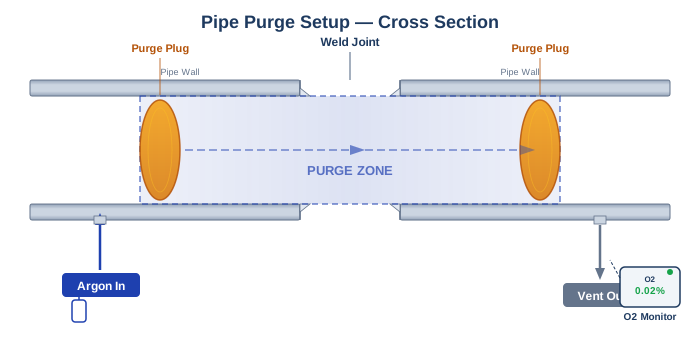
Seal your sample point. The sample line must connect to the purge zone through a sealed fitting, not through an open gap. If atmospheric air can enter the sample path, your reading will be artificially high.
Purge the sample line. Before trusting a reading, allow enough flow time for the gas in the sample tubing to be fully replaced. At typical sample flow rates (0.5 to 1.0 LPM), a 10-foot sample line needs about 30 seconds to clear.
Keep sample lines short. Longer lines mean more volume to purge and more opportunity for permeation. Nylon tubing is acceptable for readings down to about 10 ppm. For sub-1 ppm work, use stainless steel or PTFE sample lines.
Sample from the right location. You want to measure the gas at the weld zone, not at the end of a long purge chamber where the gas is freshest. Sample from the side of the purge dam closest to the weld, or through a port in the pipe wall near the joint.
Account for sample pump flow. The sample pump draws gas from the purge zone. If your purge volume is small (small bore tube with close-set dams), the sample draw rate can actually compromise the purge by pulling in atmospheric air. On small bore work, use the lowest sample flow rate possible.
Common Mistakes to Avoid
Welding based on time instead of measurement. "I purged for five minutes, it should be good" is not a purge monitoring strategy. Flow rate, purge volume, and seal quality all affect how fast oxygen is displaced. Measure it.
Ignoring sensor age. An 18-month-old electrochemical sensor that reads 30 ppm might actually be in a 60 ppm atmosphere. Track sensor install dates and replace on schedule.
Single-point measurement on large volumes. On large diameter pipe or vessels, oxygen concentration varies by location. A reading at one port does not guarantee the level at the weld joint 3 feet away. Use multiple sample points or position strategically.
Not monitoring during the weld. Starting at 20 ppm means nothing if a purge dam shifts during welding and oxygen rises to 200 ppm for the last quarter of the weld. Monitor continuously whenever possible.
Using unfiltered sample gas. Smoke, spatter particles, or moisture in the sample gas will damage sensors and produce false readings. Use inline filters on the sample line.
Equipment Recommendations
For general stainless fabrication, a quality electrochemical analyzer reading to 10 ppm is sufficient and cost-effective. Look for models with built-in sample pumps, audible alarms, and easy calibration procedures.
For pharmaceutical, semiconductor, or high-purity work, invest in a zirconia-based analyzer with data logging capability. The higher cost is trivial compared to the cost of reworking welds that failed qualification.
Shop Purge Monitors at TechSouth -- we carry both electrochemical and zirconia-based analyzers suitable for field and shop use. If you need help selecting the right monitor for your application and specification requirements, contact us.
Get the Orbital Welding Reference Pack
Sizing charts, grinding angle tables, and purge flow rates — all in one printable PDF.
No spam. Unsubscribe anytime.
Ready to get started? TechSouth Inc. carries the equipment mentioned in this guide.
Shop Equipment at TechSouthRelated Guides
Argon Purge Welding Guide for Stainless Steel
Step-by-step guide to argon purge welding on stainless steel. Covers purge setup, flow rates, oxygen levels, and common mistakes to avoid.
Purge Plug Sizing Chart for Tube and Pipe Welding
Complete purge plug sizing chart for tube and pipe welding. Find the right inflatable purge plug size by OD, ID, and wall thickness.