Argon Purge Welding Guide for Stainless Steel
Step-by-step guide to argon purge welding on stainless steel. Covers purge setup, flow rates, oxygen levels, and common mistakes to avoid.
Why Back Purging Matters
Every welder who has cracked open a stainless steel pipe weld and found a black, crusty root pass knows what happens without a purge. The backside of the weld -- the root, the part you cannot see while welding -- oxidizes when exposed to atmospheric oxygen at welding temperatures. The result is a sugared, discolored, and mechanically compromised weld root that corrodes in service, fails inspection, and has to be cut out and re-done.
Stainless steel's corrosion resistance comes from a thin chromium oxide passive layer on the surface. When the root side of a weld reaches temperatures above roughly 400 degrees F without inert gas protection, that passive layer is destroyed. The chromium combines with carbon and oxygen to form chromium carbides and heavy oxides instead of the protective passive film. The weld and heat-affected zone lose their corrosion resistance precisely where the material is most stressed.
Argon back purging displaces the atmospheric oxygen and nitrogen around the root side of the weld joint, replacing it with inert argon gas. The argon shields the molten weld pool and the heated base metal from oxidation, producing a clean, smooth, silver-colored root pass that retains the parent material's corrosion resistance and mechanical properties.
Back purging is required for virtually all stainless steel pipe and tube welding -- whether you are running orbital welds on a pharmaceutical WFI system or manual TIG root passes on a process piping spool. The principles are the same. The execution details vary by application, pipe size, and cleanliness requirements.
Equipment You Will Need
Before starting any purge welding, gather the following:
- Argon supply: Cylinder or bulk supply with regulator and flowmeter. Use welding-grade argon (99.996% purity minimum). For pharmaceutical or semiconductor work, use 99.999% or higher.
- Purge plugs or dams: Inflatable purge plugs sized to your pipe/tube ID, or alternative dam materials (water-soluble purge paper, aluminum tape). See our Purge Plug Sizing Chart for correct sizing.
- Purge hose: Low-permeability hose connecting the argon supply to the purge plugs. Standard rubber hose can allow oxygen to permeate through the wall -- use nylon or PTFE-lined hose for critical work.
- Oxygen analyzer: Digital analyzer with a range appropriate to your acceptance criteria. General fabrication work needs 0-1000 ppm range. Pharmaceutical and semiconductor work needs 0-100 ppm (or 0-10 ppm for UHP).
- Vent or exhaust path: The displaced air must have somewhere to go. Purge plugs with built-in vent holes or a separate vent connection downstream of the weld zone.
- Tape or sealing materials: High-temperature tape to seal any openings (branch connections, instrument ports, open ends) that would allow air ingress during the purge.
All purge plugs, dams, hoses, and monitoring equipment are available from TechSouth's purge equipment collection.
Step-by-Step Purge Setup
Step 1: Prepare the Weld Joint
Fit the joint with proper alignment and gap (or zero gap for autogenous orbital welding). Clean the tube or pipe ends -- remove any oil, debris, or contamination from the ID and OD surfaces at least 1 inch back from the joint. For orbital welding, ensure tube ends are faced square.
Step 2: Seal All Openings
Before inserting purge plugs, identify every opening in the purge zone -- branch connections, instrument taps, open pipe ends, valve ports. Seal all of them with tape, caps, or temporary plugs. Any unsealed opening is a leak path that allows air to re-enter the purge zone and defeat the purge.
Step 3: Insert Purge Plugs
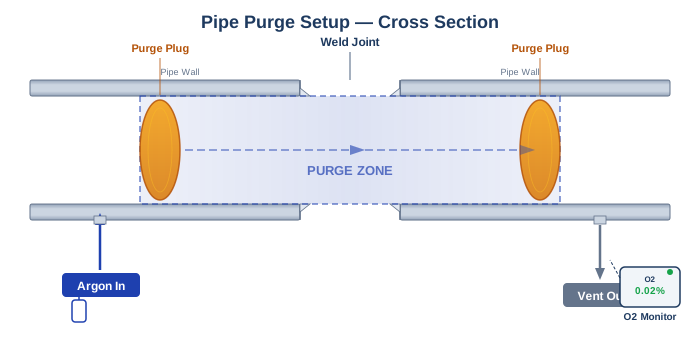
Position purge plugs on both sides of the weld joint, close enough to minimize the purge volume but far enough back to stay outside the heat-affected zone. A good rule of thumb: place plugs 4 to 6 inches from the weld centerline for tube sizes up to 2" OD, and 6 to 12 inches for larger sizes.
For inflatable plugs, insert them deflated, position them, then inflate to seal against the pipe ID. Ensure the inlet and vent connections are accessible and correctly oriented -- argon in from one side, vent out the other.
For water-soluble purge paper (purge dams), form the paper into a disc that fits snugly inside the pipe ID. These are useful when you cannot retrieve a plug after welding (the paper dissolves during system flush).
Step 4: Connect Argon and Begin Pre-Purge
Connect your argon supply to the inlet side of the purge zone. Open the vent on the downstream side. Set the flow rate (see flow rate table below) and begin flowing argon.
The pre-purge must run long enough to displace all the air in the enclosed volume. As a starting point, calculate the purge zone volume and flow enough argon to exchange that volume at least 5 to 7 times. For small-diameter tubing (under 1" OD) with plugs set close, this may take only 30 to 60 seconds. For larger pipe sizes or longer purge zones, it can take several minutes or more.
Do not guess. Use an oxygen analyzer.
Step 5: Verify Oxygen Level
Connect your oxygen analyzer to the vent side of the purge zone (or use a sensor port on the purge plug). Monitor the O2 reading as the pre-purge runs. Do not weld until the reading reaches your target:
| Application | Maximum O2 Before Welding |
|---|---|
| General stainless fabrication | < 50 ppm (0.005%) |
| Food and dairy | < 50 ppm |
| Pharmaceutical (general) | < 50 ppm |
| Pharmaceutical (WFI, clean steam) | < 10 ppm |
| Semiconductor UHP | < 1 ppm |
Once the O2 level is at or below your target, you are clear to weld. Keep the analyzer connected and monitor throughout the welding process. If the reading rises during welding, stop and investigate -- you have a leak.
For detailed guidance on oxygen monitoring equipment and technique, see our Weld Purge Monitoring page.
Step 6: Weld
With the purge confirmed, make your weld. For orbital welding, initiate the weld program. For manual TIG, start your root pass. Maintain purge flow throughout the entire welding process -- do not reduce or interrupt flow while the arc is on.
The argon purge flow rate during welding should be steady but not excessive. Too much flow creates turbulence inside the pipe that pulls in atmospheric air (see Common Mistakes below).
Step 7: Post-Purge
After the weld is complete (arc off), continue flowing purge gas until the weld zone cools below the oxidation threshold. For 316L stainless steel, this is approximately 500 degrees F. In practice, continue purging for at least 30 seconds after welding on small tubing, and 1 to 2 minutes on larger or heavier wall joints.
Removing the purge too early -- while the metal is still hot enough to oxidize -- ruins an otherwise good weld. The root side will discolor as it cools in air.
Argon Flow Rates by Pipe and Tube Size
Flow rate depends on the purge volume and the need to maintain a stable, laminar gas blanket without creating turbulence. These are starting-point recommendations:
| Pipe/Tube OD | Suggested Flow Rate (CFH) |
|---|---|
| 1/4" - 1/2" | 5 - 10 |
| 1/2" - 1" | 10 - 15 |
| 1" - 2" | 15 - 25 |
| 2" - 4" | 20 - 35 |
| 4" - 6" | 30 - 50 |
| 6" - 10" | 40 - 70 |
| 10" and above | 50 - 100+ |
These are guidelines, not absolutes. The correct flow rate is whatever maintains your target O2 level at the weld zone without excessive turbulence. Start at the lower end and increase only if the O2 reading is not dropping or is rising during welding.
Purge Dam Options
You have several choices for damming the pipe to contain the purge gas:
Inflatable purge plugs are the standard for professional pipe and tube welding. They are available in sizes from 1/4" through 96"+ ID, with built-in gas inlet, vent, and inflation connections. Quick to install and remove, reusable, and they create a reliable seal. These are the right choice for most production work. See our Purge Plug Sizing Chart for sizing guidance, or Shop Purge Equipment at TechSouth.
Water-soluble purge paper (also called purge film or purge dams) dissolves in water and can be left in the pipe after welding. Useful for situations where you cannot retrieve a plug -- long pipe runs, closed systems, or configurations where access is only from one end. Form the paper into a disc, tape it in place or wedge it into the ID, and poke a small hole in the center for gas flow.
Aluminum tape dams are a low-cost option for one-off situations. Form a dam from crumpled aluminum foil and tape it in place with high-temperature aluminum tape. Less reliable than plugs and slower to set up, but workable in a pinch. Not recommended for production welding or code work.
Foam plugs with tape can be used for non-critical work. Wrap a foam plug in aluminum tape, insert it in the pipe, and run purge gas through the gap. Crude but functional for general fabrication where the O2 spec is 50 ppm or higher.
Common Mistakes and How to Avoid Them
Insufficient Pre-Purge Time
The number one purge failure. Welders eyeball the purge time, decide "that should be enough," and strike the arc with 200 ppm of oxygen still in the zone. Use an oxygen analyzer. Every time. No exceptions.
Flow Rate Too High
More gas is not better. Excessive flow rate creates turbulence inside the pipe, which entrains atmospheric air through any small gap in the purge dam or seal. The result is an O2 reading that will not drop below a certain level no matter how long you purge. If your O2 reading plateaus, try reducing the flow rate before looking for leaks.
Removing Purge Too Early
The weld looks great on the outside, so the welder kills the purge and moves on. The root side is still at 800 degrees F and immediately oxidizes as air contacts the hot metal. Post-purge is not optional. Keep the gas flowing until the weld zone is below 500 degrees F.
Ignoring Leaks in the Purge Zone
Every unsealed branch connection, cracked fitting, loose cap, or porous tape joint is letting air into your purge zone. If your O2 reading is dropping slowly or not reaching target, you have a leak. Systematically check every connection and opening. On larger piping systems with many branches, leak checking the purge zone before welding saves significant troubleshooting time.
Using Contaminated Gas
Old regulators, dirty hoses, or bargain-grade argon can introduce moisture and oxygen into the purge. For critical work, use dedicated purge regulators that have not been cross-contaminated with other gases. Replace hoses that have been stored uncapped or exposed to the elements.
Purge Zone Too Large
Setting purge plugs too far from the weld joint creates a larger volume to purge, wastes gas, and increases the time to reach target O2 levels. Keep the purge zone as compact as practical. There is no benefit to purging 10 feet of pipe when 12 inches will do.
Welding Through a Purge Plug
Know exactly where your plugs are. Welding over a plug position melts the plug material into the weld and contaminates the joint. Mark the plug positions on the outside of the pipe before welding.
When to Use Argon vs. Other Purge Gases
Argon is the default purge gas for stainless steel welding and the right choice for the vast majority of applications. It is heavier than air (density 1.38 relative to air), which helps it settle and displace oxygen in horizontal pipe runs. It is readily available, reasonably priced, and compatible with all stainless steel alloys.
Nitrogen is sometimes used as a purge gas for austenitic stainless steels (304, 316L) in non-critical applications. It is cheaper than argon and effective at preventing oxidation. However, nitrogen is not truly inert -- at welding temperatures, it can dissolve into the weld metal and cause porosity or affect mechanical properties. It is not acceptable for duplex stainless steels (where nitrogen pickup affects the ferrite/austenite balance) or for any application where ASME BPE or SEMI standards apply. When in doubt, use argon.
Forming gas (a mixture of argon or nitrogen with a small percentage of hydrogen) is occasionally used for specific applications but is not a general-purpose purge gas.
Summary
Proper argon purging is straightforward but unforgiving -- skip a step or cut a corner and the weld fails. Seal the zone, flow the gas, measure the oxygen, weld, and keep purging until the metal cools. Do it the same way every time and your root passes will be clean, corrosion-resistant, and code-compliant.
Shop Purge Equipment at TechSouth for inflatable purge plugs, oxygen analyzers, purge hose, and related accessories.
Get the Orbital Welding Reference Pack
Sizing charts, grinding angle tables, and purge flow rates — all in one printable PDF.
No spam. Unsubscribe anytime.
Ready to get started? TechSouth Inc. carries the equipment mentioned in this guide.
Shop Equipment at TechSouthRelated Guides
Purge Plug Sizing Chart for Tube and Pipe Welding
Complete purge plug sizing chart for tube and pipe welding. Find the right inflatable purge plug size by OD, ID, and wall thickness.
Weld Purge Oxygen Monitoring: Equipment & Best Practices
Guide to weld purge oxygen monitoring. Covers O2 analyzer types, acceptable oxygen levels by application, calibration, and monitoring best practices.