Orbital Welding Troubleshooting: Common Defects & Fixes
Troubleshoot common orbital welding defects. Identify causes and fixes for lack of fusion, porosity, undercut, excessive penetration, and arc wander.
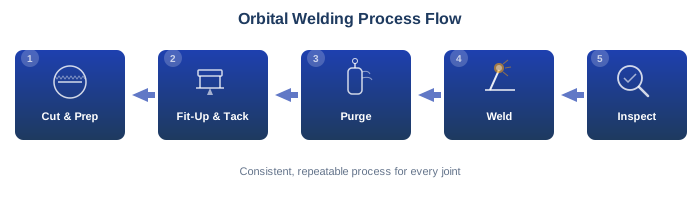
What You'll Learn
This guide is a field-ready reference for welding engineers, orbital welding operators, and QC inspectors who need to identify and correct weld defects quickly. Whether you are running autogenous tube welds on a pharmaceutical project or joining process piping in a semiconductor fab, the defect-cause-fix table below covers the problems you will actually encounter. We focus on gas tungsten arc welding (GTAW) performed with enclosed or open-style orbital weld heads, but most of the root-cause logic applies to manual TIG as well.
Bookmark this page. Print the table. Tape it to your power supply.
Prerequisites & Equipment Needed
Before you start troubleshooting, make sure you have the following on hand:
- Borescope or inspection camera -- required for ID bead evaluation on tube welds
- Calibrated flow meter -- verify both shield and purge gas flow independently
- Tungsten grinder with diamond wheel -- see our tungsten electrode grinding angle guide for correct geometry
- Micrometer or dial calipers -- confirm tube OD, wall thickness, and ovality
- Weld coupon log -- document every parameter change so you can reproduce good results
- Oxygen analyzer -- essential for purge verification, especially on stainless steel and high-purity work
Comprehensive Defect-Cause-Fix Table
| Defect | Possible Causes | Recommended Fixes |
|---|---|---|
| Lack of Fusion | 1. Travel speed too high -- the arc moves past the joint before the base metal reaches melting temperature. | Reduce travel speed by 5--10%. Verify RPM setting matches your weld schedule. |
| 2. Amperage too low for wall thickness. | Increase peak current in 2--5 A increments. Re-run a test coupon before production. | |
| 3. Poor joint fit-up -- excessive gap or mismatch. | Re-cut and deburr tube ends. Verify alignment with the weld head clamping mechanism. | |
| Lack of Penetration | 1. Insufficient heat input -- current too low or pulse frequency too high. | Increase peak amperage or reduce pulse frequency to deliver more average heat. |
| 2. Arc length too long -- electrode recessed too far into the gas cup. | Reset electrode extension per weld head manufacturer specs (typically 1/16" to 3/32" beyond the cup for enclosed heads). | |
| 3. Contaminated or oxidized joint surfaces. | Clean tube ends with acetone and lint-free wipes immediately before welding. Remove at least 1" of material if heavy oxidation is present. | |
| Excessive Penetration / Melt-Through | 1. Heat input too high -- amperage or pulse duration set above what the wall thickness requires. | Reduce peak current by 3--5 A. Shorten peak pulse duration. |
| 2. Travel speed too slow, concentrating heat in one area. | Increase rotation speed. Check that the drive mechanism is not slipping. | |
| 3. Wall thickness thinner than expected (wrong material lot, over-polished ID). | Measure actual wall thickness with a micrometer. Adjust schedule to match measured values. | |
| Porosity | 1. Inadequate shielding gas coverage -- flow too low, cup cracked, or gas line leak. | Check flow at the cup (not just the regulator). Inspect gas lines and O-rings for leaks. Typical shield flow: 15--25 CFH. |
| 2. Contaminated base metal -- oil, moisture, or residual cleaning solvents. | Solvent-clean all joint surfaces. Use only welding-grade acetone or isopropyl alcohol. Allow to fully evaporate before welding. | |
| 3. Insufficient purge -- back-purge oxygen level above 50 ppm on stainless steel. | Increase purge time or flow rate. Use an oxygen analyzer to verify <50 ppm before striking the arc. See our argon purge welding guide. | |
| Undercut | 1. Excessive amperage for the wall thickness and travel speed combination. | Reduce peak current. Increase travel speed slightly to spread heat over a wider area. |
| 2. Arc length too long, causing a wide and shallow arc cone. | Shorten electrode extension. Verify electrode is not eroded or contaminated. | |
| 3. Improper electrode position -- electrode not centered on the joint. | Re-align the weld head. Check that clamping collets are the correct size for the tube OD. | |
| Arc Wander | 1. Magnetic arc blow from residual magnetism in the workpiece or fixturing. | Degauss the workpiece. Re-route ground cables to balance the magnetic field. |
| 2. Contaminated or improperly ground tungsten electrode. | Re-grind the electrode with a proper grinding angle. Use dedicated grinding wheels for tungsten only. | |
| 3. Loose or worn drive mechanism in the weld head. | Inspect rotor, gear teeth, and drive belt. Replace worn components. See our orbital weld head comparison for head maintenance specs. | |
| Cracking (Hot or Cold) | 1. Excessive restraint on the joint -- clamping forces too high or thermal contraction restricted. | Reduce clamping force. Allow controlled cool-down before releasing the weld head. |
| 2. Wrong filler or base material -- high sulfur or phosphorus content in 316L. | Verify material certs. Confirm sulfur content is within spec (typically 0.005--0.017% for weldable 316L). | |
| 3. Cooling too rapidly -- removing purge gas or opening the weld head before the joint cools below oxidation temperature. | Maintain post-purge for a minimum of 30 seconds or until the weld zone is below 300 degrees F (150 degrees C). | |
| Discoloration / Oxidation | 1. Insufficient purge gas -- oxygen content too high on the ID during welding. | Increase purge flow and pre-purge time. Target <10 ppm O2 for pharmaceutical-grade welds, <50 ppm for general stainless. |
| 2. Post-purge time too short -- removing inert gas while the weld is still above oxidation temperature. | Extend post-purge. For 316L stainless, maintain purge until below 300 degrees F. | |
| 3. Shielding gas contamination -- moisture in gas lines or a leaking fitting. | Purge all gas lines before use. Replace old or cracked hoses. Use only welding-grade argon (99.996% minimum purity). | |
| Concavity (Suck-Back) | 1. Purge pressure too high on the ID, pushing the molten pool inward. | Reduce purge flow rate. Use a flow meter calibrated for low-range readings. Typical purge: 5--15 CFH depending on tube diameter. |
| 2. Excessive heat causing the weld pool to sink through the joint. | Reduce peak current. Check for wall thickness variation. | |
| Convexity (Excessive Reinforcement) | 1. Travel speed too high relative to heat input -- the pool solidifies before it can flow flat. | Slow travel speed or increase amperage slightly to allow the pool to wet out. |
| 2. Poor joint fit-up -- gap too tight, forcing material upward. | Ensure tube ends are square-cut and butted with minimal gap (0.000"--0.005" for autogenous orbital welds). | |
| Misalignment (Hi-Lo) | 1. Tube ends not properly squared or deburred. | Re-face tube ends with a tube squaring tool. Target perpendicularity within 0.005". See our tube facing and squaring guide. |
| 2. Weld head collet or clamping inserts worn or wrong size. | Replace collets. Verify that the collet matches the actual tube OD. | |
| 3. Wall thickness mismatch between two tube pieces from different lots. | Measure both pieces. If mismatch exceeds 10% of nominal wall, select matching material or adjust the weld schedule with current tapering. |
Systematic Troubleshooting Approach
When a defect appears, resist the urge to change multiple parameters at once. Follow this sequence:
1. Verify the Basics First
Before adjusting your weld schedule, confirm these fundamentals:
- Material: Verify alloy, wall thickness, and OD against the weld procedure specification (WPS). Measure -- do not assume.
- Cleanliness: Inspect tube ends under good lighting. Any discoloration, fingerprints, or residue can cause defects.
- Gas supply: Check shield and purge flow rates with a calibrated flow meter. Verify gas purity (welding-grade argon, 99.996%+).
- Electrode condition: Inspect the tungsten tip under magnification. Any contamination, cracking, or mushrooming requires re-grinding or replacement.
2. Isolate the Variable
Change only one parameter per test coupon. Document the starting values and the change made. Common adjustments in order of impact:
- Amperage (peak and background current)
- Travel speed (RPM)
- Pulse settings (frequency, peak/background ratio)
- Arc length (electrode extension)
- Gas flow (shield and purge)
3. Run Test Coupons
Never go straight to production after a parameter change. Run at least two consecutive coupons that pass visual and borescope inspection before resuming production welding. Document the parameters for every coupon.
4. Inspect Both Sides
On tube welds, the OD bead may look acceptable while the ID tells a different story. Always borescope the ID. For critical applications like pharmaceutical or semiconductor work, the ID bead is the primary acceptance surface.
When to Call for Support
Some problems go beyond parameter adjustments. Contact TechSouth for technical support if you encounter any of the following:
- Recurring defects that do not respond to parameter changes -- this may indicate a mechanical issue with the weld head (worn bearings, drive gear backlash, or electrode holder misalignment).
- Power supply error codes or intermittent arc starts -- could be a control board issue, a failing contactor, or high-frequency start circuit degradation.
- Weld head overheating or inconsistent rotation speed -- drive motor or gearbox wear. TechSouth stocks replacement parts and offers rental equipment to keep your project moving during repairs.
- New material or application you have not welded before -- our applications engineers can help develop weld schedules for exotic alloys, unusual wall thicknesses, or non-standard joint configurations.
Pro Tips from the Field
Keep a weld log: Record every coupon and production weld with full parameters. When a defect appears three months from now, you will thank yourself for having baseline data.
Rotate your tungsten electrodes: Mark the electrode with a reference line. If you see arc wander, rotate the electrode 90 degrees in the collet -- an asymmetric grind can steer the arc.
Pre-purge longer than you think: Most operators under-purge. Calculate your purge volume using our gas coverage calculator and add a 25% safety margin.
Check your ground connection: A poor or intermittent ground causes erratic arc behavior that mimics half a dozen other problems. Clean the ground clamp contact point and verify a solid connection before chasing other variables.
Temperature matters: Ambient temperature affects pre-heat, interpass temperature, and cooling rate. If you are welding outdoors or in an un-climate-controlled space, account for environmental conditions in your schedule.
Need Help Troubleshooting?
TechSouth provides orbital welding technical support, on-site troubleshooting, and equipment service for projects across the Southeast. Whether you need help dialing in a weld schedule or diagnosing a power supply issue, contact our applications engineering team for assistance.
Get the Orbital Welding Reference Pack
Sizing charts, grinding angle tables, and purge flow rates — all in one printable PDF.
No spam. Unsubscribe anytime.
Ready to get started? TechSouth Inc. carries the equipment mentioned in this guide.
Contact TechSouth SalesRelated Guides
Tungsten Electrode Grinding Angle Chart & Guide
Quick-reference tungsten electrode grinding angle chart. Covers recommended angles by application, material thickness, and welding process (TIG, orbital).
Orbital Weld Head Comparison: Types, Features & Selection
Compare orbital weld head types — enclosed, open, and pipe heads. Covers size ranges, applications, and how to choose the right head for your project.